
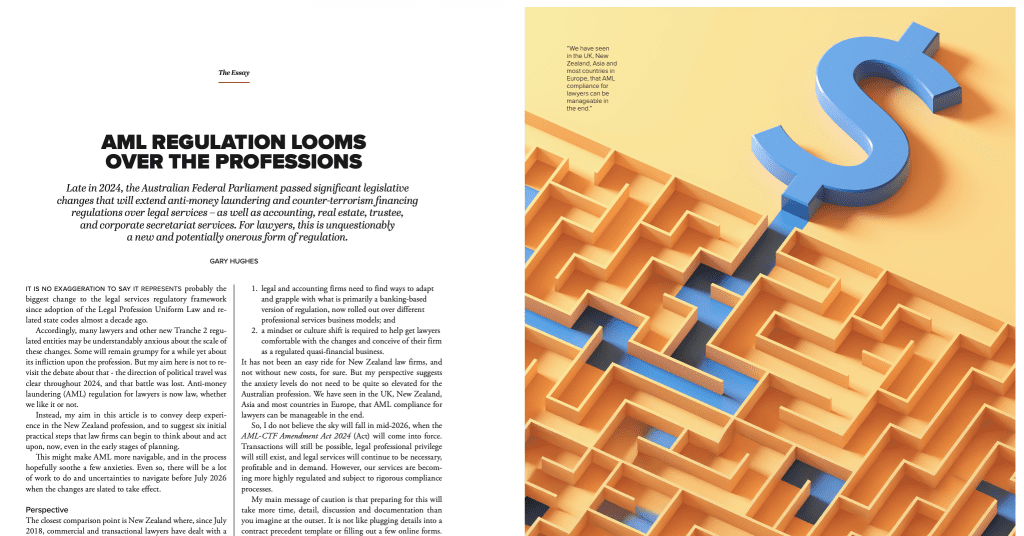
Trans-Tasman AML and Financial Crime expert Gary Hughes was invited to contribute to the Law Society Journal, regular members’ magazine of The Law Society of New South Wales on the looming tranche 2 AML regulation for Australian professionals.
In writing The Essay section for the Law Society’s publication, Gary was able to draw upon deep and detailed practical experience working with New Zealand law firms, accounting firms, financial advisors and real estate agents, where full comprehensive AML regulation has applied since 2018.
Those 7 years of the law in effect have seen a great many tricky commercial, interpretative and transactional problems having to be navigated, as lawyers deal with a very similar AML-CTF framework to what Australia will soon be getting.
The opening part of The Essay reads as follows:
“Late in 2024, the Australian Federal Parliament passed significant legislative changes that will extend anti-money laundering and counter-terrorism financing regulations over legal services – as well as accounting, real estate, trustee, and corporate secretariat services. For lawyers, this is unquestionably a new and potentially onerous form of regulation.
It is no exaggeration to say it represents probably the biggest change to the legal services regulatory framework since adoption of the Legal Profession Uniform Law and related state codes almost a decade ago.
Accordingly, many lawyers and other new Tranche 2 regulated entities may be understandably anxious about the scale of these changes. Some will remain grumpy for a while yet about its infliction upon the profession. But my aim here is not to re-visit the debate about that – the direction of political travel was clear throughout 2024, and that battle was lost. Anti-money laundering (AML) regulation for lawyers is now law, whether we like it or not.
Instead, my aim in this article is to convey deep experience in the New Zealand profession, and to suggest 6 initial practical steps that law firms can begin to think about and act upon, now, even in the early stages of planning. This might make AML more navigable, and in the process hopefully soothe a few anxieties. Even so, there will be a lot of work to do and uncertainties to navigate before July 2026 when the changes are slated to take effect.
Perspective
The closest comparison point is New Zealand where, since July 2018, commercial and transactional lawyers have dealt with a very similar AML framework. I put in place a fully working risk assessment and compliance program for new clients and instructions from that time. My experience advising, training and representing the profession through this transition drew upon a decade with a variety of financial firms, trading or gambling clients – who had been forced to think more deeply about financial crime risks.
That experience suggests two critical elements will soon become apparent in Australia:
1. Legal and accounting firms need to find ways to adapt and grapple with what is primarily a banking-based version of regulation, now rolled out over different professional services business models; and
2. A mindset or culture shift is required to help get lawyers comfortable with the changes and conceive of their firm as a regulated quasi-financial business.
It has not been an easy ride for New Zealand law firms, and not without new costs, for sure. But my perspective suggests the anxiety levels do not need to be quite so elevated for the Australian profession. We have seen in the UK, New Zealand, Asia and most countries in Europe, that AML compliance for lawyers can be manageable in the end.
So, I do not believe the sky will fall in mid-2026, when the AML-CTF Amendment Act 2024 (Act) will come into force. Transactions will still be possible, legal professional privilege will still exist, and legal services will continue to be necessary, profitable and in demand. However, our services are becoming more highly regulated and subject to rigorous compliance processes.
My main message of caution is that preparing for this will take more time, detail, discussion and documentation than you imagine at the outset. It is not like plugging details into a contract precedent template or filling out a few online forms. Firms that begin the shift into a compliance mindset sooner, and set about making business process systems alterations now, will be better placed to deal with implementation smoothly.”
… >>>
AND THOSE 6 INITIAL STEPS OR THEMES TO WORK TOWARDS IN A COMPLIANCE APPROACH:
1. Map out the services your firm offers against what is in scope for regulation;
2. Decide who will take ownership of the AML jungle and jargon;
3. Put real effort into preparing a risk assessment of your legal services;
4. Leverage off existing systems already in place, re-purposing for compliance;
5. Take the opportunity to update your tech and information management;
6. Get comfortable with having a new proactive regulator relationship.
<<< … >>>
A full copy of The Law Society Journal for April 2025 is available here from the publisher, or a plain text copy from Gary upon request email.
Recent Comments