
Gary Hughes has successfully represented the defendants in the Commerce Commission’s first ever criminal cartel (antitrust) prosecution, MaxBuild – a high profile bid rigging case in the construction sector.
After more than 20 years working on competition law & consumer law cases under New Zealand’s Commerce Act civil penalty regime, with specialty expertise in cartel and collusive conduct, Gary was at the forefront of reform that made cartels a criminal law matter from 2021 onwards.
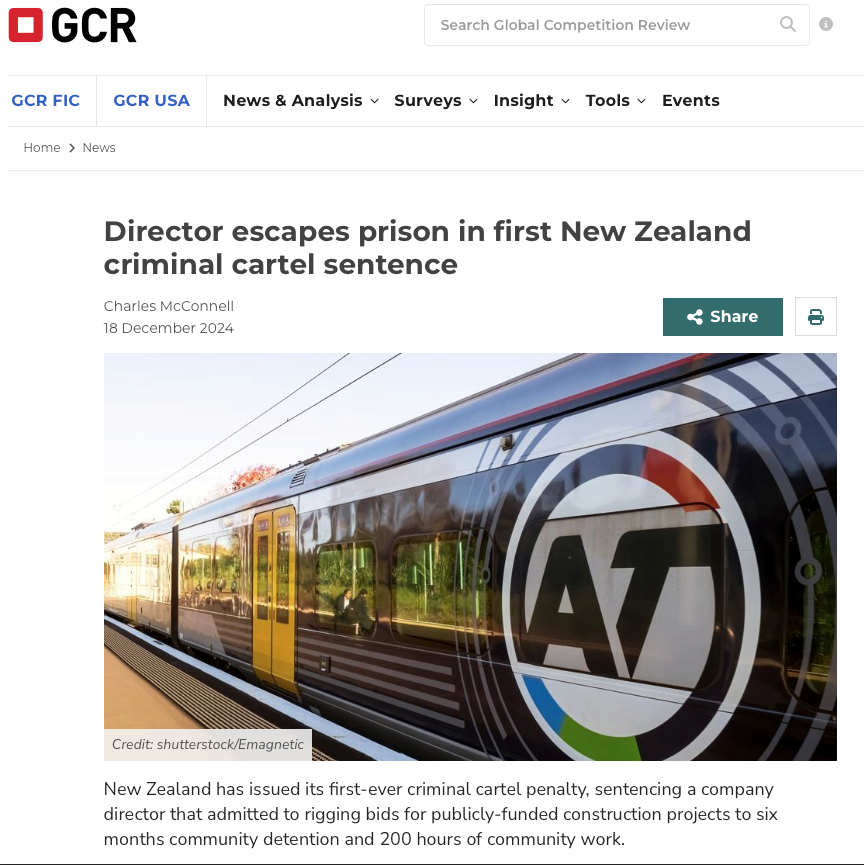
After a drawn out investigation and prosecution of bid rigging and cover pricing in specialist highway building bridge joint contracts, the director was sentenced to 6 months’ community detention and 200 hours community work, avoiding a prison sentence or home detention. The company MaxBuild was fined NZ$500,000, whereas the Commission had been seeking NZ$2m.
The Stuff News reporting at the time described the sentencing hearing, with Gary explaining that the Covid-19 lockdowns left a “great many tales of wreckage and this was one of them”. Although the company director “foolishly and unlawfully” went and initiated conversations with a competitor, he was “motivated by a desire to keep the business afloat and keep people employed”, Hughes said in closing submissions.
Steering the sensitive matter, with a lot of media attention, to a successful outcome for the defendants (significantly different to what the prosecution was pressing for) was a challenging affair, even with skill and experience. Speaking after the case’s conclusion, he said:
“Having handled a lot of cartel and bid rigging problems over the years, I was very at home on all the substantive law and competition issues. But adding criminality and risk of prison sentence certainly gives these cases a harder edge for the clients, and a few aspects of the media and criminal procedure differences might trip up inexperienced lawyers.
Still, at Britomart Chambers we invest time and effort to ensure we can cross the civil law and criminal law divide for clients when needed – skillsets and a proportionate response to handle crisis management for any client facing these serious charges. It was a privilege to represent a small business in this important test case. Our criminal law should allow flexibility enough to take all the context into account, and examine non-custodial solutions. As they say, there is almost always another side to the story. We were pleased to help get that story told.”
The company’s director was contrite and attempted to put matters right as best he could. After the conviction he issued a statement including:
“At that time, I didn’t understand that this action amounts to what is referred to as ‘big rigging’ and, since the introduction of new legislation, now carries criminal charges. Suffice to say that I have been regretting that decision ever since.
From the outset, I have been entirely open and co-operative with the Commerce Commission,
and take full responsibility. I have also tried to make amends, including offering to return the full
value of the contract to the customer ($500,000) not just any profit.”
Justice Wilkinson-Smith in the High Court acknowledged that, saying:
“The pre-sentence report describes you as remorseful and taking full responsibility. As I commented to your counsel, I have seldom seen such a positive pre-sentence report in terms of remorse.”
In New Zealand, Price Fixing was already illegal and subject to heavy civil penalties in the Commerce Act since 1986. Amendments were argued about for a decade on whether to follow North American and Australian law reforms towards criminalisation. The changes by Parliament significantly redefined and broadened the scope of what is deemed cartel conduct in section 30A of the Act, coming into force in mid-2018 and later actual conduct after 8 April 2021 can attract criminal penalties up to a maximum of potentially 7 years imprisonment. That set of law changes expressly added (alongside traditional price fixing) arrangements that affect supply or acquisition of goods or services by:
- Market Allocation;
- Restricting Output; or
- Bid Rigging (not separately defined, but treated as falling under one or other of the specific practices above).
Gary’s set of 5 articles for the Auckland District Law Society on the changes at the time are here.
The High Court case citation is: R v Maxbuild Limited & Kumar [2024] NZHC 3955 – found
here.
Recent Comments